
Also: Worldcon Sightings, ‘Star Dogs,’ a Supernatural Football Star, and More!
One of my first jobs as a journalist was at Variety newspaper, the so-called showbiz bible. At the time, the New York editorial office contained a few eccentrics, and every journalist in the bureau was a man except for me. Desks were crammed together cheek by jowl. A venerable reporter in the desk just in front of mine had several towers of press releases stacked up. I sometimes flinched at the sight of his false teeth perched jauntily on a tower right next to the aisle.
Another reporter who handled Broadway reviews delivered very good work, but due to his age, it wasn’t unusual to find him napping at his desk in the middle of the afternoon. And the editor was kind enough to let him. There were plenty of young turks, too, but I loved the older guys the most. Someone once joked that we were all there because nobody else would take us. He wasn’t speaking of the talent in that room, which was considerable, but rather the misfit nature of the whole lot. And I came to realize, the more I lived and worked in New York, that the same could be said for a large proportion of the city’s population. So many people who come to my city are like runaways who went off to join the circus—people who would feel out of place most any place else.
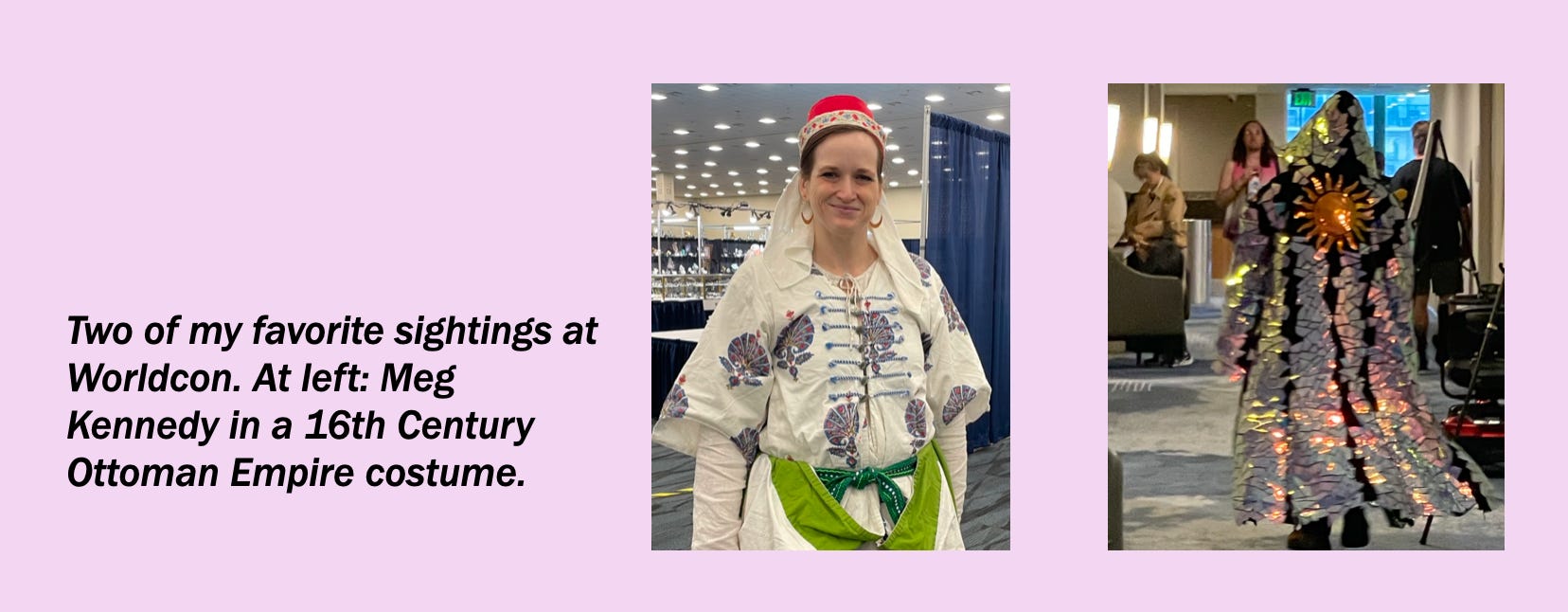
I felt a similar sensibility when I looked around at all the people who converged on Anaheim two weeks ago to attend Worldcon, the huge gathering for fans and pros who love science fiction and fantasy. Every age, many disabilities, cultural and sexual orientations—proud to be themselves, many of them in very creative costumes.
Being there felt like home, in a sense—like I feel walking around the unvarnished areas of New York, and how felt at Variety. Little wonder that showbiz and New York are at the center of my sci-fi novels.
It’s also how I think of you, dear readers—and everyone who loves far-out worlds and the strange characters within them. That’s why it gives me such pleasure to tell you what I’ve been reading and watching in the SFF space. So on with the proverbial show!
‘Dog Stars’—A Sci-Fi Thriller That Takes Time to Breathe
Fans of ‘Station Eleven’ and ‘The Last of Us’ Might Enjoy This Movie
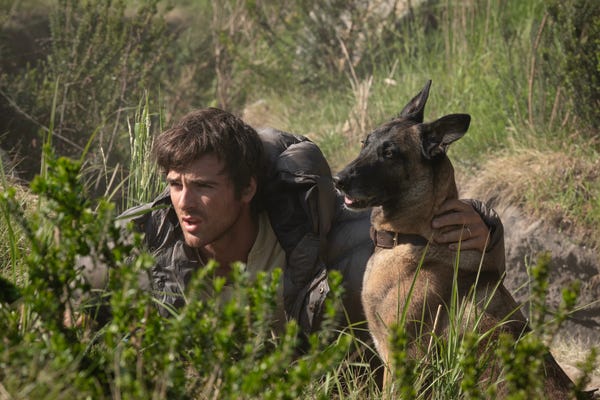
Jacob Elordi and Jasper the dog in 20th Century Studios’ The Dog Stars. Photo by Fabio Lovino. © 2026 20th Century Studios. All Rights Reserved.
It just two words to get me curious about The Dog Stars: Ridley Scott. Way back when, Blade Runner was like a gateway drug for me to go much deeper into the crazy, enthralling world of science fiction. And I admire some of his other director/producer work like The Martian and the Alien franchise. Still, I had some reservations about plunking down my money at the local theater. Dog Stars has received mixed reviews. In the end, I just had to see it for myself.
The upshot: a decided thumbs up. I’m still thinking about it, still living in that world. Adapted from Peter Heller’s bestseller, Dog Stars is a thriller with undercurrents of aching grief for a life that’s vanished. It has a similar vibe to other post-apocalypse tales like Station Eleven and The Last of Us. Meaty character roles are played Josh Brolin, Guy Pearce, and an almost ghoulish Allison Janney.
The cast is led by Jacob Elordi, who played The Creature in Guillermo del Toro’s version of Frankenstein. Elordi’s character in Dog Stars, Hig, roams the skies in his Cessna above a desolate Colorado in the aftermath of a devastating plague that wiped out much of humanity. He forages for supplies and food with his trusty dog and revisits the home he once shared with his now-deceased wife.
This isn’t a fast-paced thriller. The ruthless, violent scenes of survival are interspersed with others that give the movie room to breathe into fraught relationships, gorgeous scenery, along with the search for home and community. And in the case of Hig, there’s a growing romance with a very appealing ex-medical resident played by Margaret Qualley.
The Supernatural Football Hero
Catherynne Valente’s Lyrical Story ‘White Lines on a Green Field’

Photo by Gurdaas Malik on Unsplash
I’ve been reading a lot of short stories lately in the runup to submitting a couple of my own to sci-fi and fantasy magazines. One of my favorites was written by Catherynne M. Valente. It’s called “White Lines on a Green Field” and appeared recently in Uncanny magazine. It’s available for free, but I highly recommend a subscription (if you don’t have one already) as this is one of the finest SFF publications out there and there’s a lot of good reading in its pages.
Valente describes people and situations in unusual ways that capture the underbelly of who they truly are. Take, for example, her description of Coyote, a lead character in “White Lines”:
“I mean, yeah, he had black hair and copper skin and muscles like a commercial for the life you’re never going to have. But it was the way he looked at you, with those dark eyes that knew the answer to every question a teacher could ask, but he wouldn’t give them the satisfaction, you know? Didn’t matter anyway. Coyote never did his homework, but boyfriend rocked a 4.2 all the same.”
It’s a story about a high school football team and the fantastical hero that turned its players into near gods. And the narrator is Coyote’s main squeeze, Bunny. She’s the only one who calls his bluff when he’s lying and tells us that his kisses taste like “stolen sunshine.”
Just after reading the story, I attended an event at Worldcon where Valente gave a reading. There’s something of a goddess about her, the way she exudes sensuality and abundance and speaks with a low velvety voice. In the Q&A afterwards, I asked her about her lyrical writing style. She explained her life as a writer began as a poet and she likes to make her descriptions “pretty.” Yep, she sure does.
A Sci-Fi Classic That Resonates With Our World Today
In ‘Dispossessed,’ a Physicist Clashes With Authorities on Two Planets
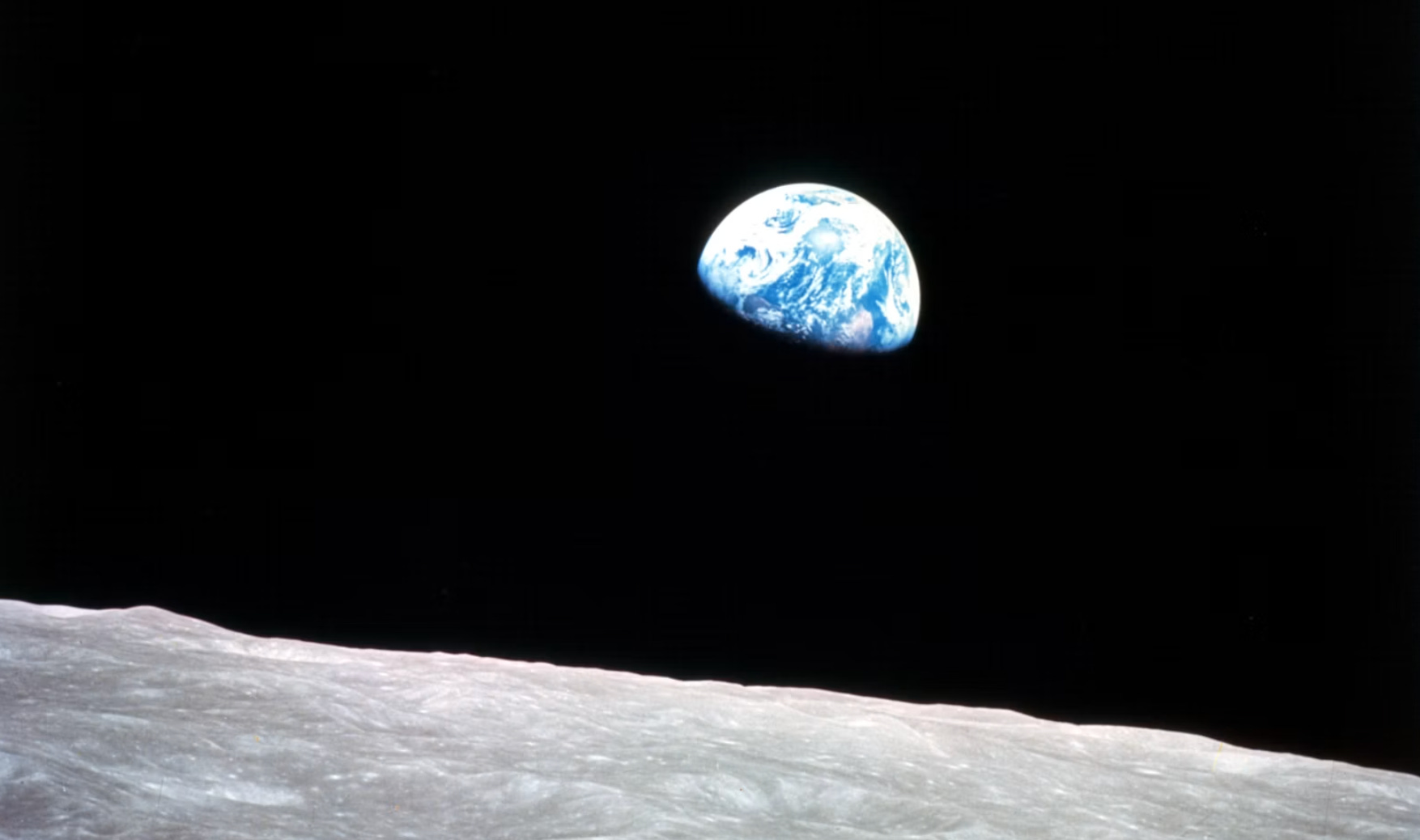
Earth and Moon, standing in for Anarres and Urras. Photo Credit: NASA
It’s been over 50 years since Ursula K. Le Guin’s novel The Dispossessed was published, and yet it still resonates with sci-fi fans quite deeply. It was discussed in two sessions I attended at Worldcon—or roughly 20% of the whole lot.
Part of it, of course, has to do with Le Guin’s masterful ability to look far into the future and sharply envision potential realities. The book focuses on the way two planets are inextricably linked by their close proximity and history. But their regard for each other ranges between cool and hostile, and they’ve have chosen to govern themselves in entirely different ways. The main character, a physicist named Shevek, does the nearly unthinkable by traveling from one to another in a search of freedom that relates to his extraordinary work.

Shevek’s struggles seem to rhyme with today’s zeitgeist in certain ways—how a whole strata of Americans are deeply disturbed by how the U.S. is governed, and how some have chosen to leave. According to the book’s entry in Wikipedia, Le Guin was partially inspired to write the book because of her opposition to America’s involvement in the Viet Nam War. That led her to study different types of societies.
Le Guin based Shevek on Robert Oppenheimer, a friend of her parents and the “father” of the atomic bomb who later had run-ins with the U.S. government. While not a direct parallel with Shevek, it’s easy to see the connection.
Also on My Radar
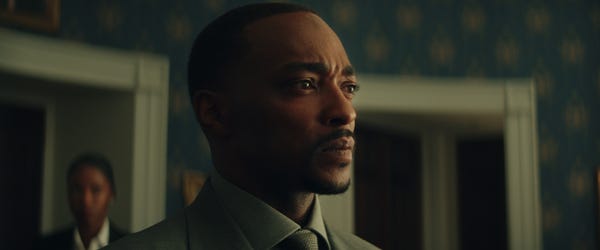
Anthony Mackie in Captain America: Brave New World, one of the viewing “assignments” before the Avengers: Doomsday premiere. Photo courtesy of Marvel Studios. © 2024 Marvel.
Marvel Has Assigned 42 Hours of Homework Before ‘Avengers: Doomsday’—Wired
Summer Box Office Breaks All-Time Record With $4.67 Billion—Variety
‘Practical Magic 2’: Bullock and Kidman Get a Flawed but Fantastical Reunion—The Wrap